


Videoart at Midnight # 164: Daniel Hopp, Kostenlos - Admission free!
Daniel Hopp is an artist and filmmaker whose practice moves between film, video installation and performance. His works often emerge from close collaborations with friends, actors, family members and people he encounters in specific social contexts. Rather than working with fixed scripts, Hopp creates situations in which participants perform versions of themselves, moving between role, biography, fiction and lived experience.
A recurring concern in his work is the relationship between staging and reality: the moment in which a performed situation begins to produce actual relationships, vulnerabilities and consequences. His films engage with intimacy, class, addiction, social marginalisation, violence and care, while repeatedly raising questions about who is looking at whom, who is speaking for whom, and how authorship is distributed within an artistic process.
Working with moving image, performance and spatial installation, Hopp develops filmic situations that remain deliberately open and process-based. The proximity between the camera and the protagonists is central to his practice. Rather than attempting to uncover an allegedly authentic reality behind performance, his work uses artistic interventions to temporarily alter existing situations. These interventions can be understood as temporary prostheses: constructions that shift particular conditions and enable different forms of action. At the centre of this approach is the question of whether such artistic interventions can become effective not only within the work itself, but also have an impact on the actual living conditions of those involved.
Daniel Hopp. who is present, shows:
Fictional Healing, 2026, 29:49 min
Places of transit, such as train stations and public squares, are sites where social divisions become particularly visible. This is the case at Leopoldplatz in Berlin or around the Drob Inn, a contact and counselling centre with drug consumption rooms near Hamburg Central Station. Addiction, homelessness and strategies for survival intersect here with urban mobility, shopping, art and culture. It is precisely at this point of convergence that Daniel Hopp’s work takes shape.
In Fictional Healing, the artist explores the socially entrenched divide between the elevated and the rejected, between the sanctioned spaces of art and those of life relegated to the margins. Drawing on his own experiences with drugs, drug-related crime and its consequences, Hopp questions the boundaries separating these worlds, exposing them not as natural or inevitable, but as social constructs. Rather than attempting to reconcile them by translating one into the language of the other, his practice allows artistic expression to emerge from their very entanglement.
In his multi-part film installation Fictional Healing (first shown Kunsthaus Hamburg, produced by Ania Maria Wanda), the artist challenges stigmatizing narratives around addiction and develops images of care that open up new possibilities for agency. Adapted for the cinema, the installation brings together humour and seriousness, creating a space of resonance in which collective imagination becomes a means of empowerment.
Drawing on his own experiences, Daniel Hopp developed documentary and (docu-)fictional film scenes in relationship-based processes of collaboration with people affected by addiction. Their personal stories, dreams and fantasies were explored through interviews and subsequently re-enacted with amateur and professional actors. Complementing these scenes, a series of cinematic portraits offers insights into the protagonists’ dreams, hopes and desires.
If there is love, you will take it, 2020, 10:45 min
If there is love, you will take it encompasses the overlappings of cinematic and everyday life constructions of reality and fiction. “Play the gangster you’d like to be” is the task the protagonists, self-proclaimed “tough boys” and the artist and director himself, take up in a cultural center and inoffical gambling spot in a red light district. What does a gangster talk like? References from oldschool gangster-films are implemented into the protagonists’ speech, and reverberate back to the speakers through the mechanical mouths of the cute stuffed talking animals sitting on the table. Questions of identity, subjectivity, role and hierarchy (both that of the art work and the artist) are a recurring theme of Daniel Hopp’s artistic practice. He works with friends, neighbours, colleagues, aquaintances from different social milieus, creating a topology of social roles and positions to locate his own position as artist. — Charlotte Klink
Daggi, 2026, 22:02 min
Together with his neighbor Daggi (Dagmar Melón) — who fled East Germany with her daughter Julia during the final week of the GDR to reunite with her husband in West Berlin, where she later worked as a private detective — the artist Daniel Hopp embarks on an inquiry that begins with the real-life death of his former tenant. What initially takes the form of a documentary investigation gradually shifts into a mode of self-reflection, staging, and reenactment.
Daggi contributes not only her keen powers of observation but also a biography shaped by political ruptures, existential uncertainty, and an ambivalent practice of caregiving. As Hopp’s artistic research becomes increasingly intertwined with Daggi’s subjective perspective, a dense constellation emerges — one that is further mirrored and questioned through the introduction of an actor (Marten-Quirin Korte) who performs the role of Hopp.
The film unfolds as a discursive space situated between documentary gesture and performative reflection. Here, identity does not appear as something given, but as a fragile construct produced through media-based processes such as reenactment, camera work, and role-play. Through the layering of autobiographical material, staged configurations, and detective-like curiosity, the work opens an inquiry into what has been repressed — without claiming any definitive resolution. — Ania Kolyszko
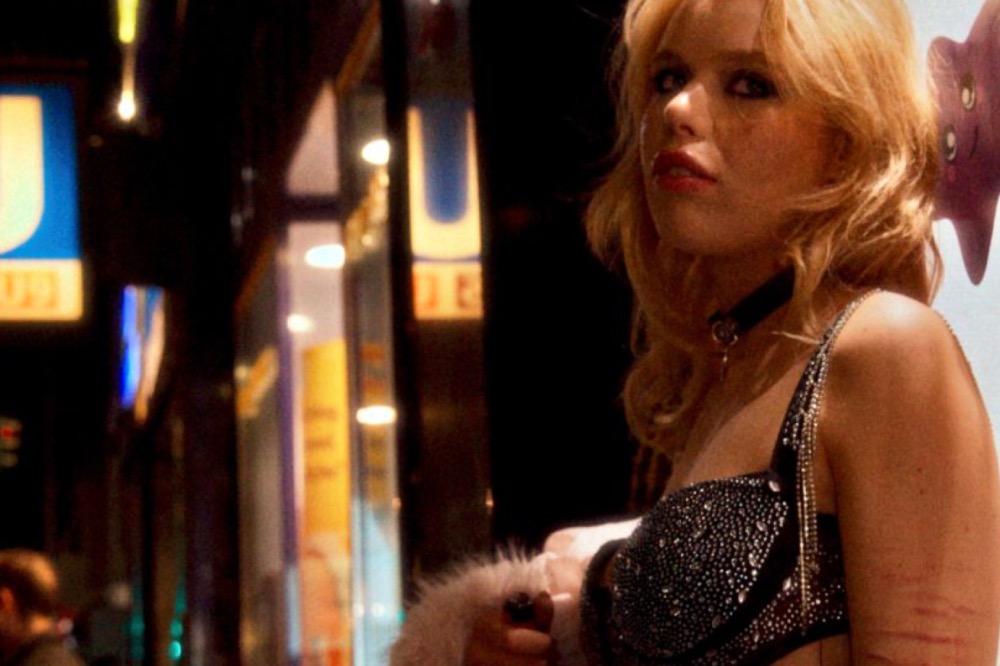
The Producer, 2026, 12:13 min (raw cut)
A young woman (Lois Zoboky) plays a prostitute. Caught between the gaze of others, sexual encounters, and the staging of her own self, she develops an intimate relationship with a steel figure. She envies it for something that is gradually slipping away from her: the possibility of simply being an object without any desire or responsibility. As fetish, art and addiction blur together, she gets increasingly lost in the expectations and projections of others. The Producertells the story of a woman, who tries to find her own place in the world, even as she slowly becomes the object others see her as.
The film grows out of Fictional Healing, Hopp’s multi-part film installation and an ongoing artistic exploration of addiction, care and self-determination. Drawing on the project’s collaborative processes and incorporating selected fragments from the installation, The Producer develops an independent cinematic narrative. Documentary and fictional scenes emerge from encounters with people affected by addiction, whose personal histories, dreams and fantasies are explored through interviews and reimagined with amateur and professional actors.
Moving between humour and seriousness, lived experience and cinematic fiction, the film challenges stigmatizing narratives surrounding addiction and mental health and proposes alternative images of care and collective imagination. It also raises questions about artistic representation: who has the right to tell whose stories, and under what conditions? Rather than offering definitive answers, The Producer opens up a space in which the boundaries between documentation and fiction, marginality and cultural visibility become fluid.
The Producer is produced by SCHEINFIRMA an initiative by Arius, Johannes Büttner, Christoph Carsten, Antje Engelmann, Daniel Hopp, Charlotte Klink and Moritz Zangerl. SCHEINFIRMA operates in the fractures of the labour market, bringing together artists, philosophers and people navigating precarious work, social services and unemployment. Without a fixed identity or structure, it borrows and redirects existing infrastructures, resources and roles to create new forms of collective artistic production. SCHEINFIRMA’s official launch will take place at Schinkel Pavillon, Berlin in January 2027.
Daniel Hopp studied Fine Arts at HFBK Hamburg and ABK Stuttgart from 2013. From 2015 to 2021, he was a scholarship holder of the German Academic Scholarship Foundation. In 2017, he received the Hiscox Art Award. In 2019, he was awarded an international scholarship by the German Academic Scholarship Foundation to study at the Royal College of Art in London, where he completed his Master’s degree in 2021. In 2022, he received the Karl Schmidt-Rottluff Scholarship.
His work has been shown in numerous national and international contexts, including Kunsthaus Hamburg, Solitude Project Space at Akademie Schloss Solitude, Stuttgart; Akademie der Künste, Berlin; Kunstverein Schwerin; Kunstverein Jesteburg; Videonale Parcours, Bonn; Künstlerhaus Bethanien, Berlin; Kunsthalle Düsseldorf; Brücke-Museum, Berlin; Haus am Lützowplatz, Berlin; Mattflix at Matt’s Gallery, London; and the International Short Film Festival Oberhausen.