


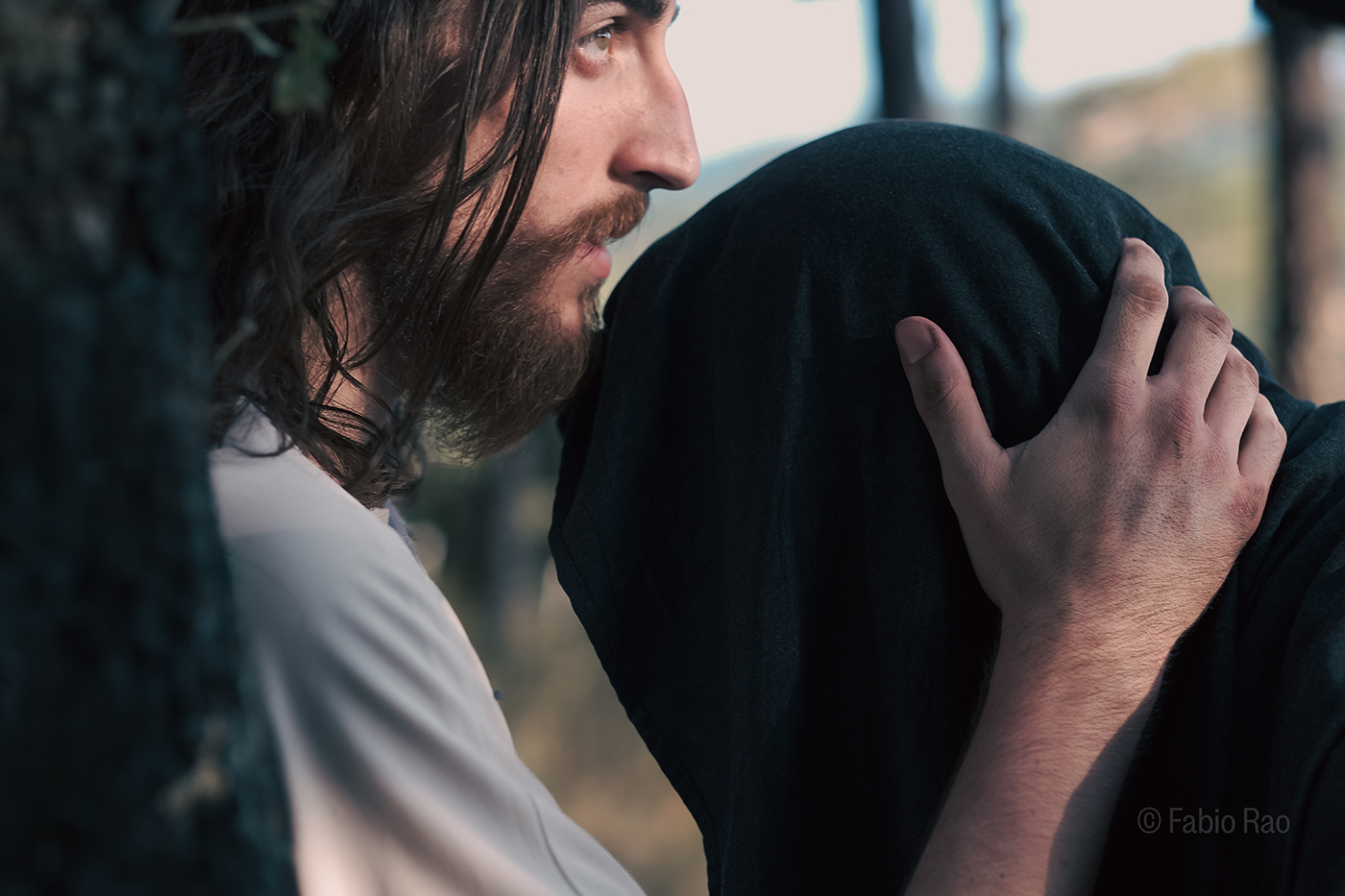
IL VANGELO DI GIUDA [OmeU] IT,PL 2025 R: Giulio Base, Starring Rupert Everett (Caifa), Paz Vega (Maria), John Savage (Giuseppe/Joseph), Vincenzo Galluzzo (Gesù/Jesus) e Darko Peric (Pietro/Peter)
Giuda/Judas Giancarlo Giannini, 93 Min
(Nur am 01.05.) Gespräch Q&A mit dem Regisseur Giulio Base und Filmkritiker und Journalist Francesco Della Calce, Moderation Matteo Forni
Er kam zur Welt, indem er bei der Geburt seine Mutter, eine Prostituierte, und seinen Zwillingsbruder tötete; dieser wurde später lange Zeit vom Besitzer des Bordells, in dem seine Mutter lebte, missbraucht, bis er ihn schließlich zusammen mit dessen Partnerin, der Bordellwirtin, umbrachte.
So präsentiert sich der verräterische Apostel Jesu als wahrer Dämon in „Il Vangelo di Giuda“ (Das Evangelium des Judas), geschrieben und inszeniert von Giulio Base, einem experimentellen Film ohne Dialoge, sondern nur mit der Erzählstimme von Giancarlo Giannini, in dem der Protagonist nie zu sehen ist, da er aus der Ich-Perspektive erzählt wird – das heißt, wir blicken durch seine Augen.
Der Film, der bereits beim Festival von Locarno großen Anklang bei den Kritikern fand und nun seit dem 2. April in Italien in den Kinos läuft, schöpft frei aus den apokryphen Evangelien und anderen heiligen Texten, gefiltert durch den Regisseur, der auch einen Abschluss in Theologie vorweisen kann. „In jedem von uns steckt ein Stück Judas. In den falschen Entscheidungen, im feigen Schweigen, in den großen oder kleinen Verratstaten, die unseren Weg durch die Welt prägen. Kurz gesagt, es ist nicht nur ein Film über ihn, sondern über diese Figur, die uns hinterfragt und uns wie in einem Spiegel widerspiegelt“, sagt Base.
ENG
He was born after his mother—a prostitute—and his twin brother were killed during childbirth; he was then repeatedly raped by the owner of the brothel where his mother lived, and at one point he kills him along with his partner, the brothel’s madam.
Thus, as a true demon, Jesus’s traitorous apostle appears in *The Gospel of Judas*, written and directed by Giulio Base—an experimental film without dialogue, featuring only the narration of Giancarlo Giannini, and in which the protagonist is never seen because the perspective is subjective: that is, we are the ones looking through his eyes.
Already a critical success at the Locarno Film Festival and now in theaters in Italy starting April 2, the film draws freely from the apocryphal Gospels and other sacred texts filtered through the director, who also holds a degree in theology. “There is a fragment of Judas in each of us. In the wrong choices, in the cowardly silences, in the betrayals - big or small - that mark our passage through the world. In short, it is not just a film about him, but about this figure who challenges us and holds up a mirror to us,” says Base.
Trailer:
ITA
Nacque uccidendo nel parto la madre prostituta e il fratello gemello, violentato poi lungamente dal padrone del bordello dove viveva la mamma, a un certo punto lo elimina insieme alla sua compagna tenutaria.
Così da vero demonio si presenta l'apostolo traditore di Gesù ne 'Il Vangelo di Giuda', scritto e diretto da Giulio Base, film sperimentale senza dialoghi, ma solo con la voce narrante di Giancarlo Giannini e dove il protagonista non si vede mai perché è in soggettiva, ovvero siamo noi a guardare con i suoi occhi.
Già al Festival di Locarno con un buon successo di critica e ora in sala dal 2 aprile in Italia, il film attinge liberamente dai Vangeli apocrifi e da altri testi sacri filtrati dal regista che vanta anche una laurea in teologia. "C'è un frammento di Giuda in ciascuno di noi. Nelle scelte sbagliate, nei silenzi vigliacchi, nei tradimenti grandi o piccoli che segnano il nostro passaggio nel mondo. Insomma non è solo un film su di lui, ma su questa figura che ci mette in discussione e ci riflette in uno specchio" dice Base.
Giulio Base
Director, actor, and screenwriter, Giulio Base is currently the Artistic Director of the Torino Film Festival.
Holding doctorates in Literature & Philosophy and Theology, and with a career spanning over 40 years, his directorial work ranges from his award-winning debut Crack (1991) to the Proust tribute À la Recherche (2023).
Besides, he worked together with Mario Girotti (Terence Hill), directing him in the western Doc West and the hit series Don Matteo.
As an actor, he was mentored by Vittorio Gassman and has collaborated with directors such as Ridley Scott and Nanni Moretti.
Francesco Della Calce
Film critic and journalist, correspondent for the daily newspaper Il Mattino and the magazine LEFT.
Director of the Enrico Appetito Archive in Rome and the Gagliardi Marino Angeloni Foundation in Cava de' Tirreni.
He recently curated “Gian Maria Volonté 30” at WEGIL in Trastevere and “CLAUDIA. La forza di una voce” (CLAUDIA. The power of a voice) for the 2025 Rome Film Festival at the Casa dell'Architettura in Esquilino.
His latest publications are "La magnifica ossessione. Il Cinema di Salvatore Piscicelli“ (Martin Eden, 2024) and ”Cartoline dall'Italia" (Giulio Perrone, 2025).
Native of Naples, he is currently the deputy director of “Corto Flegreo” in Pozzuoli, where he is also president of the jury, assisted by Valerio Caprara for the critics' award.