


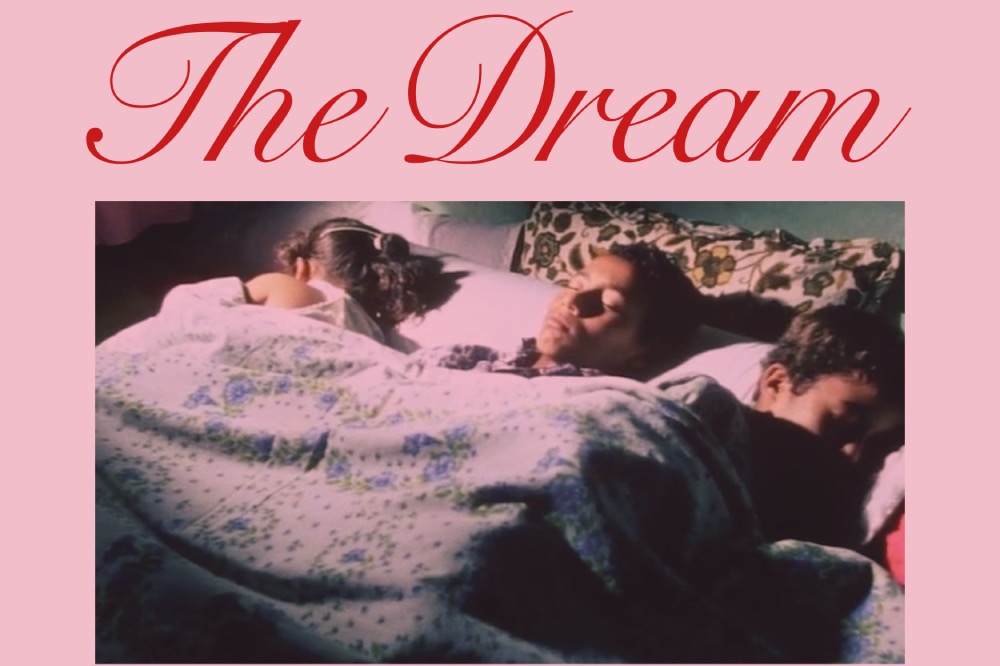
The Dream
ARTISTS: Jocelyne Saab, Jumana Emil Abboud, Kamal Aljafari, Mohammad Malas | INTERLOCUTOR: Sanabel Abdel Rahman | DURATION: 1h 50min | CO-ORGANISER: Bergen Kunsthall
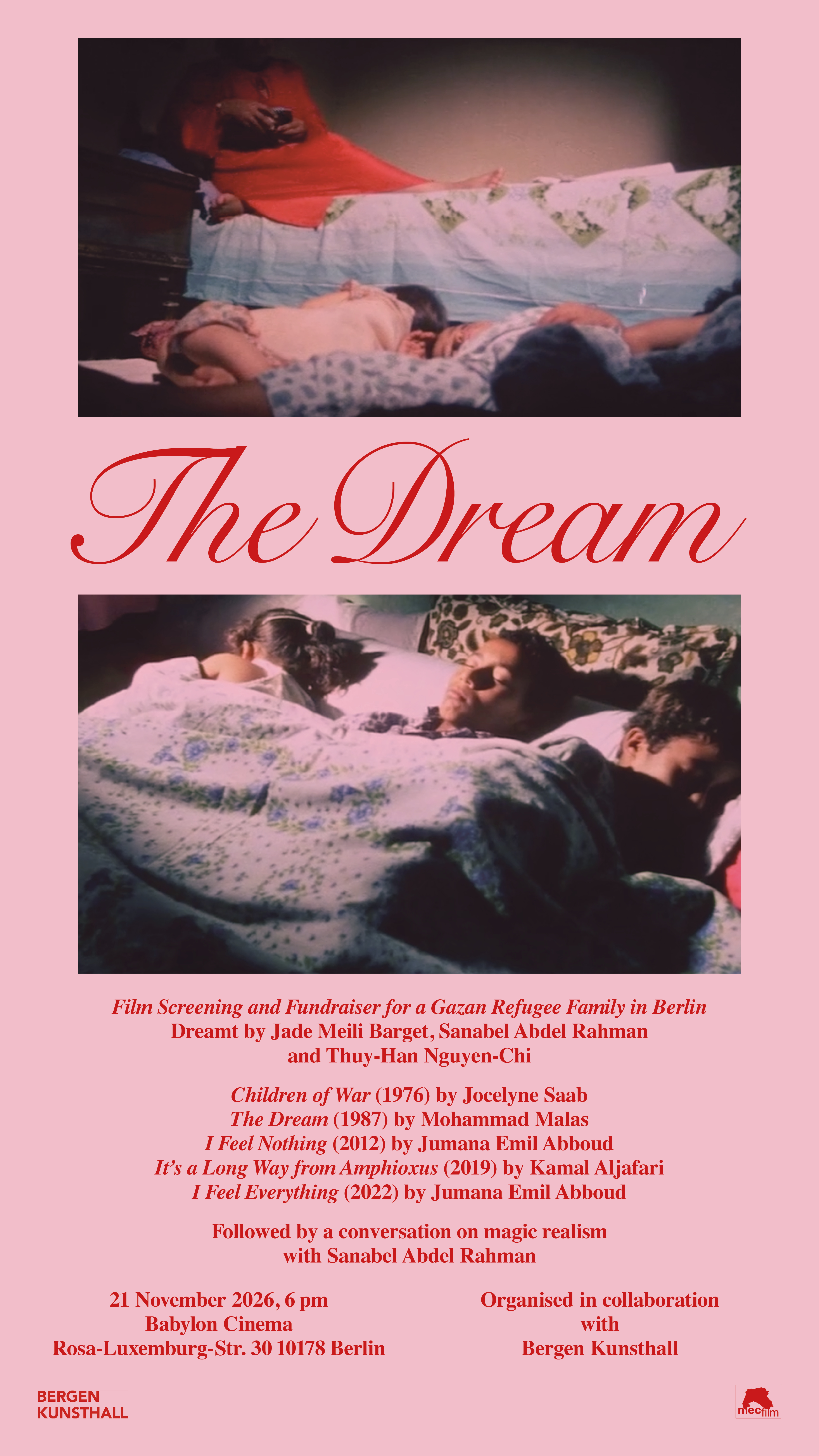 FILMS
Children of War (1976) dir. Jocelyne Saab. 10 mins.
The Dream (1987) dir. Mohammad Malas. 44 mins, 48 sec.
I Feel Nothing (2012) dir. Jumana Emil Abboud. 8 mins, 6 sec.
It's a Long Way from Amphioxus (2019) dir. Kamal Aljafari. 16 mins, 17 sec.
I Feel Everything (2022) dir. Jumana Emil Abboud. 9 mins.
EVENT DESCRIPTION
2019. In the grey corridors of an administrative office in Berlin, exiles daydream as they wait for their turn to be called. 1976. Children survivors of the Karantina massacre, refugees in their own country, play at war. 1980. Displaced Palestinians in Lebanon dream of their lands by night. Somewhere, a woman tells a tale a thousand years old, of a half-child born from a half-eaten pomegranate.
Join us for a screening of films by Jocelyne Saab, Jumana Emil Abboud, Kamal Aljafari and Mohammad Malas, carrying us through millennia of vivid and insistent dreams of freedom, reunion and a nourishing land, set against the deadly dreams of oppressors.
Following the screening, a conversation with researcher, literary critic and assistant professor Sanabel Abdel Rahman will take place online. Her work engages folk tales, magical realism, Indigenous climate fiction and speculative writing, and explores liberatory imaginations, (re)connection with the land, decolonial writing, and the activation of alternative realities. She is the author of the forthcoming book Magical Realism in Palestinian Literature and Folk Tales: Reading the Distorted Spaces of the Nakba (2027) and of Māʼ Ward (2026), a work of Arabic autofiction and analog photography.
This event is dreamt by Jade Meili Barget, Thuy-Han Nguyen-Chi and Sanabel Abdel Rahman to fundraise for a Gazan refugee family of six living in Berlin. All proceeds will go to helping the family pay rent for their temporary housing. Conceived in gratitude for Bergen Kunsthall’s support.

Children of War (1976) dir. Jocelyne Saab. 10 mins.
Days after the massacre in Karantina, a predominantly Muslim shanty town in Beirut, Jocelyne Saab finds and meets children who have escaped, and who are deeply traumatized by the horrific fighting they have seen with their own eyes. Jocelyne gives the children crayons and encourages them to draw while her camera rolls. She makes a bitter discovery: the only games the children engage in are war games. The war would quickly become a way of life for them as well. Words collected by Zahraa Mortada.
The Dream (1987) dir. Mohammad Malas. 44 mins, 48 sec.
Over one year, from 1980 to 1981, Mohamad Malas interviewed more than 400 Palestinian refugees in camps from the refugee camps of Sabra, Shatila, Bourj el-Barajneh, Ain al-Hilweh and Rashidieh in Lebanon, asking them about their dreams at night. The psychological landscape it paints is one that returns, again and again, to Palestine. The 1982 Sabra and Shatila massacres took the lives of many people he interviewed, and interrupted the project. The director returned to the footage in 1986, editing it into this 45 minute film, released in 1987.
I Feel Nothing (2012) dir. Jumana Emil Abboud. 8 mins, 6 sec.
Conceived as a poem, Jamana Emil Abboud’s film departs from the Palestinian fairytale The Handless Maiden in order to investigate fragmented land and the exiled and annexed self, body, homeland and language. Emerging from this search, is the artist’s longstanding concern with touch as it elucidates the relationship between the body and memory, between land and its spiritual history.
It's a Long Way from Amphioxus (2019) dir. Kamal Aljafari. 16 mins, 17 sec.
An old woman leans to the young man with the yellow book sitting next to her and asks, “What are they distributing here?” “Numbers”, he replies. In Berlin’s waiting rooms, where metal and wooden seats are nailed to the ground, people arrive after emerging from the seas. Here they wait. Kamal Aljafari’s new short film once again collapses time, questioning the meaning of life in a system in which humanity is reduced to a number and the value of one’s future is measured by applications within grey hallways. Step into this black hole, where bones and flesh have become numbers in a queuing system. This surreal film observes the origins of our being versus the future of how we are defined. What have we become from our point of origin until today’s chaos of bureaucratic mazes? It’s a long way from Amphioxus, we all came from there.
I Feel Everything (2022) dir. Jumana Emil Abboud. 9 mins.
The Palestinian folk tale "Half-a-halfling [Nos Nsais]" recounts an alienated half-child born of magic, and imagines a story of a spirit half-child, invisible and annexed from her native home. The work circles around the “half-child”figure, as well as other water folklore, reflecting on fragmental beingness.

BIOGRAPHIES
JOCELYNE SAAB (1948-2019) was a war reporter, documentary filmmaker, fiction filmmaker and experimental artist. After working as a correspondent for French television in Libya, Egypt, Syria and Iraq, she covered the Lebanese civil war, as well as the armed struggle in Western Sahara and the aftermath of the Iranian Revolution. She also worked for many years in Egypt, from which she was banned for seven years because of her political documentary work, and following her first two fiction feature films shot in Lebanon, Ghazl Al-Banat (1985) and Once Upon a Time in Beirut (1994), she shot Dunia (2006) in Cairo. She later turned to photography, installation art and video art, and is considered a major figure in Lebanese cinema.
JUMANA EMIL ABBOUD is a Palestinian-Canadian artist with a multidisciplinary practice exploring cultural memory, lore, and relation with the more-than-human. Her drawings– often worked with handmade inks and pigments–explore the afterlives of folk tales and water lore; while multi-dimensional works in beeswax, olive wood, textiles etc., are votive assemblages charged with imaginal and material enchantments. Her video poems and spoken word for performative practice are entangled story divinations where myth and lived experience are continuously Interwoven. Abboud has presented at Jameel Arts Centre, de Appel, Cample Line, Documenta, TAVROS, TBA21-Academy, Seoul Museum of Art, Casco Art Institute, Darat al Funun, Bildmuseet and BALTIC, and the Biennales of Diriyah, Sydney, Venice, Qalandiya, Istanbul and Sharjah. Recognitions include the Pernod Ricard Fellowship, the Jameel Fellowship at the Victoria & Albert Museum, London, in collaboration with the International Glass and Visual Arts Research Centre (Cirva), Marseille (2024-2025). Abboud holds a PhD in Fine Art and is currently based in London, UK.
Palestinian filmmaker and artist KAMAL ALJAFARI is known for his distinctive approach to cinema. He studied at the Academy of Media Arts in Cologne and has held teaching positions at The New School in New York and the Deutsche Film-und Fernsehakademie in Berlin. He was awarded a Radcliffe Fellowship at Harvard University and most recently a fellowship at The Columbia Institute for Ideas and Imagination in Paris (2024–2025). As from September 2025, he is a resident at Académie des beaux-arts x Cité internationale des arts in Paris. His installation “The Camera of the Dispossessed” was shown at the 35th Bienal de São Paulo in 2023. Aljafari was also honored at IndieLisboa 2024 with a full retrospective of his work at the Portuguese Cinematheque as well as at the Madrid Spanish Cinematheque in 2025. The feature film “A Fidai Film” (2024) was shown in over hundred festivals and won around 10 international awards. His most recent work, “With Hasan in Gaza” (2025), premiered in the International Competition at Locarno Film Festival, where it was awarded with the Europa Cinemas Label. The film has received main awards at DMZ Docs, Yamagata International Documentary Film Festival, CINEMED, Festival dei Popoli and is currently shortlisted for the European Film Academy.
Born in 1945 in Quneitra in the Golan, MOHAMMAD MALAS is a Syrian writer and director. He is one of the most prominent auteur filmmakers in Syria. He studied philosophy in Damascus University then completed his cinema studies at The Russian State University of Cinematography in Moscow in 1974, where he directed several short films. Upon his return, Malas joined Syrian TV where he achieved several narrative and non-fiction shorts before embarking on his feature-length journey with films that tackle critical social and political issues that gained regional and international recognition. Among his award winning and internationally acclaimed films are “Dreams of the City” (1984), “The Night” (1992), “The Dream” (1987), “On the Sand”, “Under the Sun” (1998), “Passion” (2005) and “Ladder to Damascus” (2013). Malas has headed and joined jury committees in numerous national and international film festivals.
DREAMERS
JADE MEILI BARGET is a curator based between France and Norway working as Live Curator at Bergen Kunsthall. Her practice engages live formats with a focus on performance cultures, moving images, and experimental discourse. In 2025–2026, she was curator in residence at the Museum of Art and History in Geneva, where she developed the performance programme First Impressions, casting a contemporary gaze on early image technologies. In 2024, she was co-curator and co-editor of the 15th Gwangju Biennale, Pansori: A Soundscape of the 21st Century, a sonic investigation into the spatial transformations of our present. From 2021 to 2024, she was part of the curatorial team of the transmediale festival in Berlin, dedicated to post-digital cultures.
SANABEL ABDEL RAHMAN is a Palestinian writer, researcher, and literary critic currently based in Amman. She completed her undergraduate and master’s degrees at the University of Toronto and holds a Ph.D. in Arabic literature with a focus on magical realism from Marburg University. She was a postdoctoral fellow at EUME (Germany), MECAM (Tunisia), and BBQ+ (U.S.). She holds the position of assistant professor at the Applied Science University in Amman. Sanabel is the author of the forthcoming book Magical Realism in Palestinian Literature and Folk Tales: Reading the Distorted Spaces of the Nakba (2027) and of Māʼ Ward (2026), a work of Arabic autofiction and analog photography. She is also the co-founder of Ayn Hawd, an initiative for interdisciplinary learning and artistic research. Her work engages folk tales, magical realism, Indigenous climate fiction, and speculative writing, which she expands on through a variety of public-facing initiatives. Across her academic, pedagogical, and creative practices, she explores liberatory imaginations, reconnection with the land, decolonial writing, and the activation of alternative realities. Her texts have appeared in academic journals, magazines, and art exhibitions.
THUY-HAN NGUYEN-CHI is a Milky Way-based artist whose practice mutates in and out of film, sculpture, installation, and performance. Interweaving real and fictional characters in search of consciousness, language, and freedom, she explores the epistemological, aesthetic, and political possibilities of image and sound. Her work has been presented in art and cinema contexts, including Carpenter Center at Harvard University, Cambridge; Hamburger Bahnhof, Berlin; Whitechapel Gallery, London; New York Film Festival; Rencontres Internationales Paris/Berlin; and Singapore International Film Festival. She has performed at Haus der Kulturen der Welt, Berlin; Maxim Gorki Theater, Berlin; Migros Museum of Contemporary Art, Zürich; and Musée d’Art et d’Histoire, Geneva. She is currently a PhD researcher at the Centre for Research and Education in Art and Media, the University of Westminster.
GRAPHIC DESIGN
Studio Ghazaal Vojdani